Outdoor Stair and Railing Contractor in Utah County, Utah
If your deck stairs have gone spongy, your front steps have dropped at one corner, or there is a run of steps in the yard with nothing to hold onto, that is the work we do. We build and repair outdoor stairs across Utah County — Lehi and Saratoga Springs down through American Fork, Orem and Provo, out to Spanish Fork and Payson.
Licensed Utah Contractor (#12042862-5501), fully insured, and owner-run by Jorge Bustos since 2011. Every job starts with a free on-site look and a written price — book yours here or call (801) 608-6241.
Railings: the one most people call about
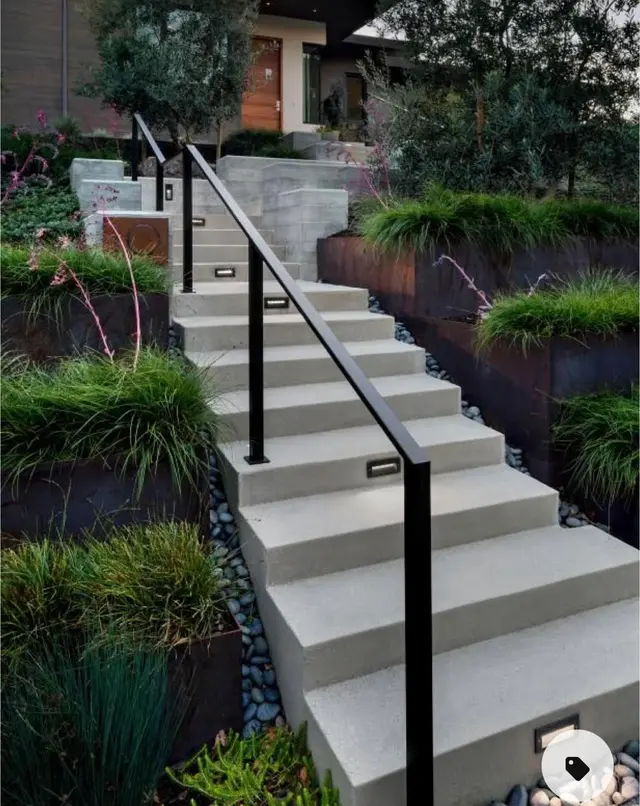
A set of outdoor steps without a railing is the most common thing we get asked to fix in Utah County, and usually for one of three reasons — someone in the house has started finding the steps difficult, a home inspection flagged it during a sale, or the steps were built before the current code and nobody noticed until they had to.
Utah residential code requires a graspable handrail once you have four or more risers, and a guard where the drop beside the steps is over 30 inches. We will tell you on site which applies to yours. Retrofitting a railing to existing steps is usually straightforward on concrete and timber; on stone it depends on what the treads are set into, which is why we look before quoting.
Deck Stairs
Utah County's newer subdivisions are full of walkout basements and raised decks, which means a lot of deck-to-yard stair runs — and a lot of them were built to the minimum.
What we see fail first:
- Stringers cut too thin, so the run flexes underfoot. It feels alarming long before it is actually unsafe, and it is the usual reason people call.
- Bottom landings set on soil rather than a footing. The stairs move as the ground moves, and the top connection starts pulling away from the deck.
- Fasteners that were never rated for exterior use, which rust out and leave the stringers hanging on rust.
- We rebuild deck stairs on proper footings below frost line, with stringers sized for the actual run rather than the minimum, and hardware rated for outdoor use.
Front Steps, Porch Steps and Stone
Concrete steps crack and settle here for the same reason driveways do: freeze-thaw gets into a hairline crack, water freezes and opens it, and clay soil moves underneath through the seasons. Sometimes that is a repair. Often the base has gone and it is a rebuild — we will say which yours is rather than patch something that will be back.
For stone and brick steps we build over a proper drainage base, so spring runoff does not wash the base out from under the treads. That matters more on the benches than it does on the valley floor.
Hillside and Sloped Lots
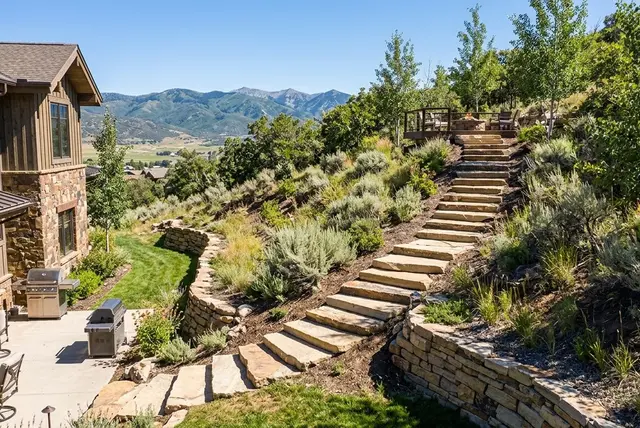
A lot of Utah County housing sits on a grade — the benches along the east side, the ground rising toward the Point of the Mountain, the older parts of Provo and Springville. Steps on a slope are a different job from steps on flat ground: the run has to be set out so the risers stay equal the whole way, the base needs drainage so runoff goes around rather than through, and on a long run you are often building small retaining walls as well as stairs.
That is a thing to price after standing on it, not before.
What Utah County Does to Outdoor Stairs
- Freeze-thaw. The valley cycles above and below freezing repeatedly through the winter. Every cycle works water further into whatever cracks exist.
- Clay soil. Much of the county sits on clay that swells when wet and shrinks when dry. Anything set shallow moves with it.
- Spring runoff. Snowmelt moves a lot of water fast, especially on a bench lot, and it undermines step bases that were not drained.
- High-altitude sun. It is hard on untreated timber and on cheap coatings, so material choice matters more here than the catalogue suggests.
Getting a Price
Call (801) 608-6241 or use the quote form. Tell us roughly how many steps and whether it is a repair or a rebuild; we will come and look before putting a number on paper. Free, and no obligation.
We have an ACI Concrete Flatwork Associate on the crew (Joshua Bustos) — relevant here because most outdoor stair work sits on concrete, and the base is what decides whether it lasts.