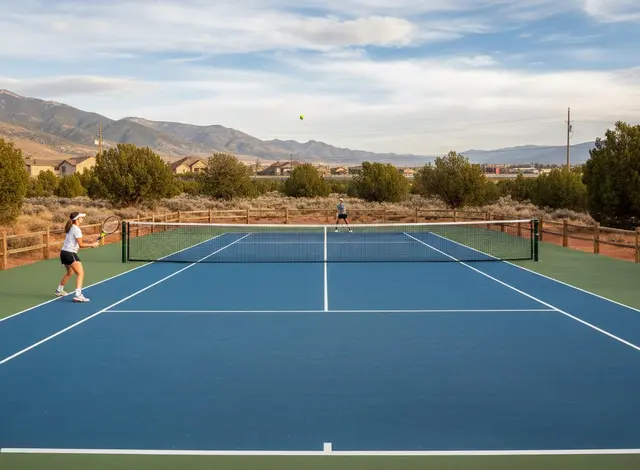
Tennis Court Resurfacing and Construction in Salt Lake County, Utah
Need a tennis court resurfaced, repaired, or built from scratch in Utah? We resurface and build tennis, pickleball, and basketball courts across Salt Lake County, Utah County, and the Wasatch Back — from a worn backyard court that needs new acrylic to a full post-tension slab on raw ground.
Bustos and Sons Construction has been building in Salt Lake County since 2011. Courts here take a specific kind of beating: high-altitude UV fades surface color faster than at sea level, and the freeze-thaw cycle opens hairline cracks into structural ones within a couple of winters. We build and resurface for those conditions specifically.
Here's What We'll Cover
- Tennis court resurfacing across Utah — crack repair, recoating, and when it's worth doing
- New court construction — site prep through final line painting
- Pickleball courts and tennis-to-pickleball conversions
- Basketball and multi-sport courts — see our backyard sport use court page
- Court fencing, painting, and maintenance
- Investment planning — transparent pricing and timeline expectations
Tennis Court Resurfacing in Salt Lake County
Most courts in Utah need resurfacing every 5–7 years — sooner on a south-facing court with no shade. Resurfacing costs a fraction of replacement and buys back most of the court's life, so it's worth checking before assuming you need a rebuild.
- Visible cracks wider than 1/8 inch
- Faded or worn court lines
- Standing water more than an hour after rain (birdbaths)
- Rough, slick, or uneven playing surface
- Peeling or flaking acrylic
We resurface tennis, pickleball, basketball and multi-sport courts — including multi-court facilities — throughout Salt Lake County, Utah County, Park City, and Heber. Sport use court resurfacing is cheaper per court when several are done together, so if you have a multi-court site it's worth scheduling them at once.
New Tennis Court Construction in Salt Lake County and Park City, Utah
New Tennis Court Installation
Building a tennis court in Midvale requires understanding our local soil conditions, drainage requirements, and weather patterns. The Wasatch Range creates unique challenges with spring runoff and freeze-thaw cycles that can damage improperly constructed courts.
Our comprehensive installation process includes:
- Site Analysis and Preparation: We begin every project with detailed soil testing and drainage assessment. Midvale's clay-heavy soil requires specific excavation depths and base materials to prevent settling and cracking. Our team removes 18-24 inches of existing soil, depending on your property's grade and drainage patterns.
- Foundation and Base Construction: Using locally-sourced crushed limestone and proper compaction techniques, we create a stable foundation that handles Utah's temperature variations. This includes installing French drains and proper grading to direct water away from your court surface.
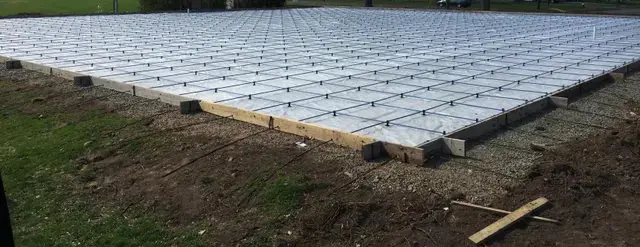
- Slab Construction: Post-tension concrete or conventional reinforced concrete, or an asphalt base where that suits the site and the budget. Post-tensioning is a method of building the slab, not a surface: steel cables run through the pour and are tightened against anchors at the slab's edges in stages as it cures — not once at the end — which holds the whole slab under compression. Concrete is strong in compression and weak in tension, so keeping it squeezed is what stops it cracking when the clay underneath swells and shrinks through the seasons. On a Utah court that is usually the difference between a slab that stays flat and one you are patching in five years.
- Surface System: The playing surface goes on top of the slab — acrylic coatings in the colour and speed you want, or a cushioned system if you want more give underfoot. Chosen on how the court will be used, not on what the base is made of.
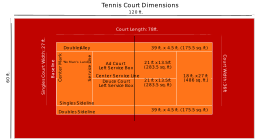
- Professional Line Marking: Using regulation USTA measurements and high-quality court paint, we ensure precise line placement for both tennis and pickleball configurations when requested.
Do You Need a Post-Tension Slab, or Will Standard Concrete Do?
This is the decision that costs the most to get wrong, so here is the plain answer for each sport.
What actually decides it
Beyond the sport, four things push a slab toward post-tension:
- Span. The longer the slab, the more ground variation it has to bridge. This is why court length drives the decision more than anything else.
- Expansive soil. Much of the Salt Lake Valley sits on clay that swells when wet and shrinks when dry. A conventional slab cracks where that movement concentrates; a post-tension slab is held in compression and rides it as a single piece. On Utah clay this is usually the deciding factor.
- Slab thickness. Post-tensioning carries the same load in a thinner slab, which can matter where you are working to a finished height — matching an existing patio, or keeping a drainage fall.
- How flat it has to stay. If long-term movement is unacceptable, tensioned cables actively resist deflection rather than just holding the pieces together after the fact.
When standard reinforced concrete is the right call
Post-tension is not automatically better, and we will say so on site. A small, square, well-drained slab on stable ground does not need it — the sub-base preparation and the control joints matter more, and the money is better spent on getting those right and on the surface system. Recommending post-tensioning where it is not needed is a way of making a job more expensive, not better.
We will tell you which one your site needs before there is a price on paper. Book a free on-site quote or call (801) 608-6241.
Pickleball Court Installation and Services
New Pickleball Court Construction
Pickleball has exploded in popularity throughout Midvale and the greater Salt Lake area. Our pickleball court construction follows USA Pickleball Association guidelines while adapting to local conditions.
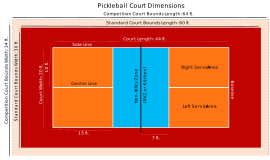
- Dimensions and Layout: Standard pickleball court lines measure 20' x 44' with specific net height requirements and no-volley zone markings. We can install standalone pickleball courts or design combination tennis/pickleball layouts that maximize your available space. The dimensions of the court are usually 30' x 60'. Competition size courts often go to 36' x 64' or 36' x 70'. Premium stadium courts can be 40' x 80' or larger, but those are usually for commercial or club use.
- Surface Considerations: Pickleball requires consistent ball bounce and player safety. We recommend textured acrylic surfaces that provide optimal traction without being abrasive. Our non-slip coating systems meet ADA requirements while delivering tournament-quality play characteristics.
- Construction Costs: Typically ranges around $28,500 for a basic installation to $79,000 for a premium level court. With our premium options available for multi-color surfaces, integrated lighting, and custom fencing you can expect to invest more for a high-end court. We provide detailed written estimates after site evaluation.
Pickleball Court Resurfacing
Converting an existing tennis court to pickleball, or refreshing an aging pickleball surface, comes down to line placement and surface prep. A single tennis court fits two pickleball courts comfortably, and we can stripe for both sports on one surface using color-coded lines so you don't have to choose.
Our resurfacing includes:
- Complete surface evaluation and crack repair
- Color-coordinated line systems for multi-sport use
- Premium acrylic coating application
- Professional line striping with proper measurements
Court Fencing Solutions
Tennis Court Fencing
Proper fencing protects players, contains balls, and enhances your court's appearance. Utah building codes require specific fence heights and gate configurations for residential tennis courts.
- Chain link with privacy slats (most popular in Midvale)
- Vinyl-coated chain link for enhanced durability
- Custom powder-coated steel for premium installations
- Windscreen integration for weather protection
- We install 10-foot fencing on ends and 8-foot on sides, following USTA recommendations. All gates include self-closing hardware and proper latch mechanisms for safety.
Pickleball Court Fencing
Pickleball courts require 10-foot fencing minimum due to the sport's unique ball trajectory. We design fencing systems that accommodate both sports when courts serve dual purposes. Often referred to as multi-sport courts. Pickleball courts are the most combined courts for sports. You can easily have a half basketball court added to a pickleball court. Tennis courts have lots of room for combining multiple court sports into one.
Special considerations include:
- Acoustic fencing options for noise control
- Proper gate placement for equipment access
- Wind resistance calculations for Utah's canyon winds
- Integration with existing landscape features
Court Painting and Maintenance
Professional Court Painting
Utah's extreme weather demands high-quality court paint and proper application techniques. We use only commercial-grade acrylic coatings designed for outdoor sports surfaces.
- Surface preparation including pressure washing and crack filling
- Primer application for optimal paint adhesion
- Base coat application using professional spray equipment
- Line marking with precision measuring tools
- Final protective coating for extended durability
Ongoing Maintenance Services
Regular maintenance extends court life and maintains playing quality. We offer annual maintenance contracts including:
- Crack monitoring and repair
- Surface cleaning and treatment
- Line repainting as needed
- Fence maintenance and repair
- Drainage system inspection
Knowing Your Local Area
Understanding Utah's Unique Requirements
Building courts in Salt Lake County and Park City, Utah presents specific challenges that out-of-state contractors often overlook:
- Soil Conditions: Our valley's clay soils expand and contract significantly with moisture changes, requiring specialized base preparation and drainage systems.
- Weather Patterns: Rapid spring snowmelt creates drainage challenges, while intense summer heat can damage improperly installed surfaces.
- Local Regulations: Midvale City requires specific setback distances and drainage considerations for new court construction that we navigate efficiently.
Investment and Timeline Planning
Tennis Court Construction Costs
Tennis court construction represents a significant investment that adds substantial value to Midvale properties. Costs vary based on:
- Level lots: Standard pricing
- Sloped terrain: Additional excavation and retaining wall costs
- Poor drainage areas: Enhanced drainage system requirements
- Difficult access: Equipment mobilization considerations
- Post-tension concrete: Highest initial cost, lowest lifetime maintenance
- Asphalt with acrylic: Balanced cost and performance
- Cushioned systems: Premium option for player comfort
- Lighting systems for extended play
- Fencing upgrades and privacy options
- Landscaping integration
- Equipment storage solutions
Project Timeline Expectations
Typical construction timelines in Midvale:
- Planning and Permits: (2-4 weeks) Site surveys, engineering drawings, and city permit approval process.
- Construction Phase: (3-6 weeks) Weather dependent, with longer timelines during Utah's wet spring season or colder months. Painting can only be completed in dry conditions above 60°F.
- Final Details: (1-2 weeks) Line painting, fence installation, and final site cleanup.
- Curing: We schedule most projects during Midvale's optimal construction season (May through October) to ensure proper curing and surface adhesion.
Why Professional Construction Matters
The Difference Experience Makes
After years building courts throughout Salt Lake County, we've seen the costly consequences of inexperienced installation. Common problems with substandard construction include:
- Foundation Failures: Inadequate excavation and base preparation leads to settling, cracking, and premature surface failure. Repairs often cost more than proper initial construction.
- Drainage Problems: Poor drainage design creates standing water, surface damage, and potential liability issues. Utah's clay soils require specific drainage solutions that general contractors often overlook.
- Surface Quality Issues: Improper surface application results in inconsistent ball bounce, premature wear, and safety concerns. Professional installation ensures tournament-quality playing conditions.
- Assurance: We maintain full licensing and insurance coverage, including specialized liability protection for sports facility construction.
Getting Started with Your Court Project
Free Consultation and Site Evaluation
We begin every project with a free site visit to work out what the ground will take and what you want to play on. During that visit we:
- Measure available space and assess site conditions
- Discuss surface options and feature preferences
- Identify potential challenges and solutions
- Provide preliminary timeline and investment estimates
- Review local permit requirements and processes
Design and Engineering Services
Our team includes certified engineers familiar with Utah building codes and soil conditions. We provide:
- Professional site surveys and topographic analysis
- Custom court design and layout optimization
- Structural engineering for challenging terrain
- Complete permit application and approval management
Next Steps
Whether you need an existing court resurfaced or a new one built, we'll come look at the site and give you a written estimate. We work throughout Salt Lake County, Utah County, Park City, and Heber.
Frequently Asked Questions
A: Resurfacing a standard tennis court typically runs a fraction of replacement cost, with the final figure depending on how much crack repair and patching the surface needs first. Courts with structural cracking or drainage problems cost more because those have to be corrected before any coating goes down. We give a written estimate after seeing the court.
A: Every 5 to 7 years for most Utah courts. South-facing courts with no shade fade faster because of high-altitude UV, and any court that holds water after rain will deteriorate sooner. If your lines are faded or you can see cracks wider than 1/8 inch, it's time.
A: Yes. We resurface tennis, pickleball, basketball, and multi-sport courts, and we can restripe a single surface for more than one sport using color-coded lines. Multi-court facilities are cheaper done together than one at a time.
A: Yes, this is one of our most common requests. A single tennis court fits two pickleball courts comfortably. We can either convert fully or stripe for both sports on the same surface so the court stays usable for tennis.
A: Usually yes, particularly for excavation, drainage work, fencing over a certain height, and any lighting. We handle permit applications and inspections as part of the project.
A: Salt Lake County, Utah County, Wasatch County and Park City. That includes Midvale, Sandy, Draper, Cottonwood Heights, Salt Lake City, Lehi, Provo, Orem, Heber and surrounding communities.
Contact Information:Phone: (801) 608-6241Licensed General Contractor in Utah • Licensed Utah Contractor (#12042862-5501) • Fully Insured • Better Business Bureau A+ Rating • Certified • LocalTransforming Midvale and surrounding area homes with quality craftsmanship and exceptional service since 2011. Your vision, our expertise, exceptional results.We serve all of Salt Lake County, Utah County and Wasatch County, including Midvale, Sandy, Draper, Cottonwood Heights, Murray, Millcreek, Taylorsville, South Jordan, West Jordan, South Salt Lake, The Avenues, The Upper Avenues, Federal Heights, The East Foothills, East Bench, Mount Olympus, Woodridge Terrace, Arcadia Heights, Holladay, Riverton, Herriman, Bluffdale, West Valley, Alta Vista, Salt Lake City, Emigration Canyon, East Centra, Yalecrest, Wasatch Hollow, Sugar House, Canyon Rim, Liberty Wells, White City, Wilmington, Kearns, Magna, Oquirrh, Tooele, Park City, Heber, Lehi, Saratoga Springs, Eagle Mountain, Alpine, American Fork, Highland, Pleasant Grove, Cedar Hills, Lindon, Orem, Vineyard, Provo, Springville, Mapleton, Spanish Fork, Salem, Woodland Hills, Elk Ridge and Payson.