Basketball and Sport Use Court Contractor in Salt Lake County, Utah
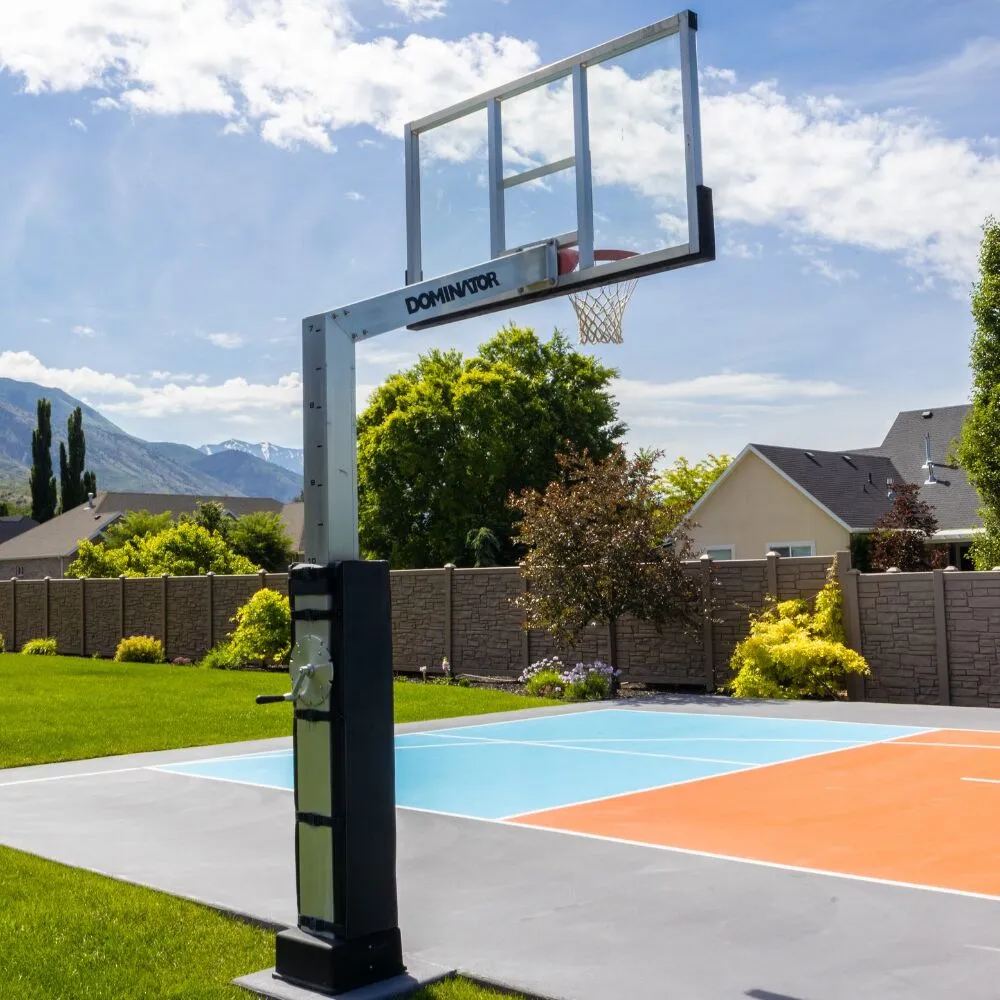
Looking for a basketball court contractor who understands Utah's unique climate challenges? Whether you're planning a backyard half-court in Draper or a full regulation court for your Sandy neighborhood, building a quality basketball court in Salt Lake County requires expertise in freeze-thaw cycles, proper drainage for mountain runoff, and materials that can handle our temperature extremes.
Since 2011, Bustos and Sons Construction has built many residential and commercial basketball courts throughout Salt Lake County. We've learned exactly what works at 4,200+ feet elevation and what doesn't.
What This Guide Covers
Here's what we'll cover to help you make the right decision for your basketball court project:
- Court design options for different property sizes and budgets
- Material choices that perform in Utah's climate
- Cost breakdowns specific to Salt Lake County projects
- Timeline expectations from permits to first game
- Maintenance requirements to protect your investment
- Common problems we see from improper installation
Why Basketball Court Construction in Salt Lake County Is Different
Building a basketball court in Sandy isn't the same as building one in Phoenix or Seattle. Our elevation, freeze-thaw cycles, and clay-heavy soils create specific challenges.
- Temperature swings in Salt Lake County can exceed 40 degrees between day and night, especially in spring and fall. This constant expansion and contraction destroys poorly installed courts within 2-3 years. We've repaired dozens of courts where contractors didn't account for this.
- Clay soil throughout most of Salt Lake Valley retains water and shifts with seasonal changes. In areas like Riverton, West Jordan, and Herriman, we always excavate deeper and add 4-6 inches of crushed gravel base—not the standard 2-3 inches used in other regions.
- Winter drainage matters. When snow melts on your court in February, that water needs somewhere to go. Without proper pitch and drainage channels, water pools, freezes, and cracks your surface. We've seen this destroy $30,000 courts in South Jordan neighborhoods.
Types of Basketball Courts We Install
Concrete Basketball Courts
Concrete remains the most popular choice for residential courts in Salt Lake County. It's durable, relatively affordable, and provides excellent ball response.
- 4-6 inch reinforced concrete slab (thicker than standard residential concrete)
- Fiber mesh reinforcement plus rebar grid on 18-inch centers
- Control joints every 10 feet to manage cracking
- 0.833% slope for drainage
- Minimum 28-day cure time before painting or coating
- A finished half court (30' x 30') runs $17,500-$23,500 in Salt Lake County. Full courts (50' x 84') run $77,500-$90,500, depending on site preparation and the surface you choose.
- We've installed concrete courts in every Salt Lake County city—from Bluffdale to Cottonwood Heights. The average lifespan with proper maintenance exceeds 20 years.
Asphalt Basketball Courts
Asphalt offers a softer playing surface and slightly better shock absorption than concrete. It's common for school courts and municipal facilities but works well for large residential properties too.
- Lower initial cost (typically 15-20% less than concrete)
- Faster installation time
- Easier to repair and resurface
- Better joint health for frequent players
- Requires resurfacing every 3-5 years in Utah's climate
- Can develop soft spots in extreme summer heat
- Needs thicker base layer in clay soil areas
- We recommend asphalt for properties over one acre where a full-size court makes sense, or for customers planning to install sport tiles on top.
Modular Sport Tile Courts
Interlocking sport tiles install over existing concrete or asphalt. We've added sport tiles to dozens of aging courts throughout Murray, Taylorsville, and West Valley City.
- Excellent shock absorption (reduces joint stress by 30-40%)
- Quick installation (most courts complete in 1-2 days)
- Multiple color options for custom designs
- Better traction in all weather conditions
- Can cover cracked concrete
- Sport tiles go over an existing base, so the cost turns on whether that base is sound. We quote the tiles and any base work together rather than separately.
Our Basketball Court Installation Process
1. Site Evaluation and Planning (Week 1)
Every Salt Lake County project starts with a property visit. We evaluate:
- Soil conditions through test excavation
- Existing slope and drainage patterns
- Property access for equipment
- Utility locations (we call Blue Stakes of Utah)
- HOA requirements if applicable
- Setback regulations for your city
- In areas like Holladay and Millcreek with mature trees, root systems affect excavation. We've worked around dozens of established landscapes—sometimes the court location needs adjustment to preserve trees.
2. Permits and HOA Approval (Week 2-3)
Salt Lake County requires permits for basketball court construction. Each city has different requirements:
- Salt Lake City: Building permit required, 10-foot setback from property lines
- Sandy City: Zoning clearance needed, surveys required for courts over 1,000 sq ft
- Draper: HOA approval often needed, city permit for grading over 50 cubic yards
- Herriman: Building permit plus drainage plan for lots over 0.25 acres
- We handle all permit applications. Our relationship with local building departments typically speeds up approval.
3. Excavation and Base Preparation (Week 4)
This phase determines whether your court lasts 5 years or 25 years.
- Remove 10-14 inches of soil (deeper in clay areas)
- Grade base to proper slope for drainage
- Install 4-6 inches of ¾-inch crushed gravel
- Compact with vibratory roller (95% compaction minimum)
- Install 2-3 inches of road base
- Final compaction and laser leveling
- In South Jordan and Riverton, we often encounter clay at 12-18 inches. We remove it entirely and replace with engineered fill—it costs more upfront but prevents the settling issues we see in courts built by less experienced contractors.
4. Concrete or Asphalt Installation (Week 5)
For concrete courts, we pour in sections using fiber-reinforced concrete with minimum 3,500 PSI strength. On larger courts, or on the clay that moves most, we also build post-tension slabs — steel cables run through the pour and are tightened against anchors at the edges in stages as it cures, holding the slab under compression so the soil underneath can move without cracking it. Most residential court builders do not offer it. Rebar grid goes in before the pour.
- Pour only when temperatures are 40-85°F
- Add control joints for expansion/contraction
- Proper finishing creates ideal ball bounce
- Minimum 28-day cure before coating
- We've poured courts in every weather condition Salt Lake County offers. Spring and fall provide ideal conditions. Summer pours require special curing compounds to prevent surface damage.
5. Line Painting and Surface Coating (Week 8-9)
After full cure, we apply acrylic surface coating—typically two base coats plus two color coats.
- Regulation basketball lines (high school or NBA dimensions)
- Free throw lanes and three-point arcs
- Key area and center circle
- Optional: pickle ball lines, four-square court, custom logos
- We use 100% acrylic paint designed for Utah's UV exposure. Cheaper latex paints fade within one season.
6. Equipment Installation (Week 9-10)
- In-ground hoops (most stable, regulation height)
- Adjustable systems (popular for families with young kids)
- Wall-mounted hoops (space-saving for small courts)
- For in-ground systems, we dig 48 inches deep—deeper than the 36-inch frost line in Salt Lake County. The pole gets set in concrete separate from the court slab to prevent cracking.
- We install Goalrilla, Mega Slam, and Silverback systems most often. These brands hold up to Utah winters.
Basketball Court Costs in Salt Lake County
Actual costs vary based on site conditions, but here's what most 2024-2025 projects run:
Half-Court (30' x 30')
That covers the base, the playing surface, a hoop, and the fencing and lighting most people want with it. Where a project sits in the range comes down to the base you choose and what the site needs before we can pour.
Full Court (50' x 84')
Same scope at twice the area, two hoops, and lighting sized for the whole surface.
Properties in Cottonwood Heights, Draper, and Sandy typically choose full courts. Half-courts dominate in Murray, West Jordan, and Magna where lot sizes are smaller.
What Affects Your Price
Maintenance Requirements for Utah Basketball Courts
Seasonal Maintenance
- Power wash entire surface to remove winter grime
- Inspect for cracks or settling from freeze-thaw
- Check drainage and clear any blocked channels
- Repair any winter damage before coating season
- Hose down weekly to prevent dirt buildup
- Check for surface coating wear
- Reapply paint to faded lines if needed
- Monitor for drainage issues during summer storms
- Deep clean before winter
- Apply crack filler to any developing cracks
- Check hoop stability and tighten bolts
- Consider resurfacing if coating shows wear
- Remove snow promptly (within 24 hours)
- Never use metal shovels (plastic only)
- Avoid salt or ice melt products
- Don't allow snow to freeze to surface
Long-Term Maintenance
We offer maintenance contracts for commercial courts and high-use residential courts. Annual inspections catch small problems before they become expensive repairs.
Common Basketball Court Problems (And How We Prevent Them)
Cracking
We've repaired courts throughout West Valley and Kearns where contractors poured thin concrete (3 inches) over inadequate base. These courts crack within 1-2 years.
Settling and Uneven Surface
Properties in Riverton, Herriman, and South Jordan need extra attention. We've re-leveled courts where contractors didn't account for clay soil characteristics.
Poor Drainage and Pooling Water
Standing water destroys acrylic coatings and accelerates concrete deterioration. We've never had a drainage callback on our courts.
Surface Coating Failure
Courts we coated 8-10 years ago in Sandy and Cottonwood Heights still look good. Cheap coatings fail in 2-3 years.
Basketball Hoop Problems
We've reset dozens of hoops installed by handymen who put them only 24-30 inches deep. These lean within months.
Choosing the Right Basketball Court Size
Backyard Half-Court (30' x 30')
Perfect for most residential properties in Salt Lake County. This size accommodates:
- Full free throw line distance
- Three-point shooting practice
- 3-on-3 games
- Driveway practice
- Popular in Murray, Midvale, and Taylorsville where lot sizes are 0.15-0.25 acres.
Large Half-Court (35' x 45')
Better for serious players. Includes:
- Partial three-point arc
- More space for dribbling drills
- Better 3-on-3 play
- Room for multiple shooters
- Common in Sandy, Draper, and South Jordan on 0.25-0.5 acre lots.
Full Regulation Court (50' x 84')
Rare in residential settings but popular for:
- Large estate properties
- Private training facilities
- Youth sports organizations
- Multi-family developments
- We've installed full courts in Draper foothills and on larger Herriman properties. Requires significant space and investment.
Custom Sizes
Many Salt Lake County properties have irregular shapes or space constraints. We've built:
- Narrow courts (25' x 50') for side yards
- Small pads (20' x 20') focused on shooting practice
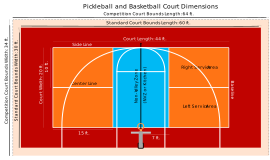
- Multi-sport courts with basketball and pickleball
- The key is maximizing usable space while staying within budget.
Sport Use Court Construction: Multi-Sport and Backyard Courts
Most of what we build in Salt Lake County isn't a single-sport court — it's a sport use court sized to the yard and striped for whatever the family actually plays. As a sport use court builder we handle the whole range: basketball, pickleball, tennis, volleyball, and combination layouts on one surface.
- Basketball + pickleball — the most requested combination in Utah County and Salt Lake County
- Half-court basketball — the best use of a standard suburban back yard
- Pickleball-primary courts with a single hoop added
- Full multi-sport courts with color-coded striping for three or more sports
- Sport use court installation costs less per square foot the larger the pad gets, so if you're deciding between a small single-sport pad and a slightly larger multi-sport court, the multi-sport version is usually better value. We build backyard sport use courts throughout Salt Lake County, Utah County, Park City and Heber.
Basketball + Pickleball
Most popular combination. One basketball hoop with pickleball lines added. A 30' x 40' court accommodates both sports comfortably.
Adds pickleball lines and a portable net system to the quote.
Basketball + Volleyball
Requires more space. Minimum 30' x 50' recommended. We install ground sleeves for volleyball net posts.
Adds ground sleeves and a net system to the quote.
Basketball + Hockey
Growing in popularity. Requires smooth surface (sport tiles or sealed concrete) and containment boards.
Adds boards and a hockey-specific surface to the quote.
Properties in Sandy and Draper often choose multi-sport designs. Maximizes usability year-round.
Post-Tension or Standard Concrete? It Depends on Your Court Size
For basketball this is genuinely a size question, not a default.
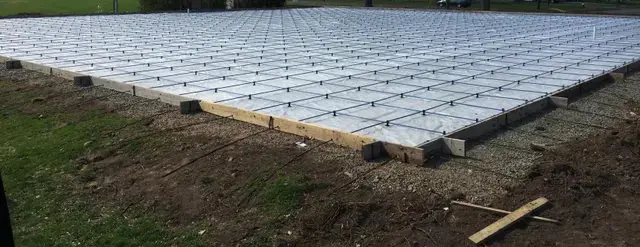
- Half court, around 30 by 30: a small, square slab. Conventional reinforcement with control joints cut on time usually handles it well. Spend the money on sub-base preparation and the surface instead.
- Full court, 50 by 84: a much longer slab, and length is what turns soil movement into a crack. On the clay through Riverton, West Jordan and Herriman we will normally recommend post-tension.
- The reason is the ground, not the game. Much of the valley sits on clay that swells when wet and shrinks when dry. A conventional slab cracks where that movement concentrates; a post-tension slab is held in compression and rides it as a single piece.
- By comparison, tennis courts are 60 by 120 and effectively always want post-tension, and larger multi-court pickleball installations usually do — there is a fuller explanation on our tennis and pickleball court page.
- We will tell you which your site needs before quoting. Book a free on-site quote or call (801) 608-6241.
Lighting Your Basketball Court
Utah summer evenings are perfect for basketball, but proper lighting extends playing time into fall and spring.
LED Court Lighting
Modern LED systems provide:
- Bright, even illumination (50-75 foot-candles)
- Low energy costs
- 50,000+ hour lifespan
- Instant on/off (no warm-up time)
We install courtside switches and optional timers. Many customers add motion sensors or app controls.
Lighting Regulations
Most Salt Lake County cities allow residential court lighting with conditions:
- Lights must aim downward (no light pollution)
- Automatic shut-off by 10 PM
- Distance requirements from property lines
- Check your city's ordinances. We handle all lighting permits.
Fencing and Containment
Fencing serves multiple purposes for basketball courts.
Chain Link Fencing
Most economical option. Available in 4', 8', 10', and 12' heights.
- Durable in Utah weather
- Keeps balls contained
- Security for equipment
- Low maintenance
- Popular in West Jordan, Magna, and Kearns.
Vinyl-Coated Chain Link
Adds color and protection. Available in black, green, or brown.
Common in Sandy and Draper where aesthetics matter more.
Privacy Fencing
Wood or vinyl privacy fence creates enclosed court space.
- Complete privacy
- Wind protection
- Noise reduction
- Aesthetic appeal
- Popular in Cottonwood Heights and Holladay.
Partial Fencing
Many customers fence just the back and sides (leaving front open). Reduces cost while containing most errant balls.
We install fence posts in concrete footers below frost line. Gates include self-closing hinges and lockable latches.
Why Property Owners Throughout Salt Lake County Choose Bustos and Sons Construction
14 Years of Local Experience
Since 2011, we've built basketball courts in every Salt Lake County city. We understand:
- Local soil conditions
- City permit requirements
- HOA approval processes
- Utah's unique climate challenges
- We're not a national franchise following a one-size-fits-all approach. Every court gets designed for its specific location.
We Do the Work Ourselves
Our crews handle every phase—excavation, base prep, concrete work, coating, and equipment installation—which keeps quality control and accountability with us.
When problems arise (and they sometimes do), you deal directly with us—not a call center.
Warranty
The whole court — base, surface and equipment installation — carries our one-year workmanship warranty — see what it covers. Surfacing products and hoops carry their manufacturers' own warranties, which we hand to you at the end of the job.
Transparent Pricing
Written estimates include everything—permits, base prep, concrete, coating, lines, and basic cleanup. No surprise charges.
We explain cost differences between options so you can make informed decisions.
Local References
We provide phone numbers for recent customers in your area. Talk to Sandy homeowners about our work in Sandy. Ask West Jordan customers about our West Jordan projects.
Most of our business comes from referrals. We've built multiple courts in the same neighborhoods throughout Draper, Herriman, and South Jordan.
Frequently Asked Questions
Properly built concrete courts in Salt Lake County last 20-30 years with basic maintenance. Surface coatings need renewal every 5-8 years. We're still maintaining courts we built in 2011-2014.
Base preparation and concrete work require specialized equipment and expertise. DIY courts often fail within 3-5 years due to settling, drainage issues, or cracking. The cost to fix a failed DIY court usually exceeds hiring professionals initially.
April through October offers ideal conditions. Spring and fall provide best pricing. Summer works but requires extra attention to concrete curing. We don't pour concrete when temperatures drop below 40°F.
Most Salt Lake County HOAs require approval for basketball courts. Requirements vary—some need landscaping plans, setback verification, or design approval. We help navigate this process.
Quality courts typically add value for buyers with children or basketball interests. Courts in poor condition can hurt value. Location matters—courts are more valuable in areas with larger lots and family-oriented neighborhoods.
Remove snow promptly with plastic shovels. Never use salt or ice melt. Don't allow ice to build up. Cover hoops if possible. Most Utah winters are mild enough that courts only need snow removal 5-10 times per season.
Yes, though a slope adds retaining walls, extra excavation and engineered drainage to the scope. We've built courts on properties throughout the Draper bench and Sandy foothills.
Small cracks (hairline to 1/4 inch) are normal and easily repaired during resurfacing. Larger cracks indicate base problems. We evaluate cracks free of charge and recommend appropriate repairs.
Getting Started With Your Basketball Court Project
Step 1: Free Consultation
We visit your property to evaluate site conditions and discuss your goals. Bring photos or examples of courts you like. We'll discuss size options, materials, and budget ranges.
No pressure sales. We explain what works for your property and why.
Step 2: Detailed Proposal
Within 3-5 days, you'll receive a written proposal including:
- Court specifications and materials
- Complete cost breakdown
- Timeline from start to finish
- Warranty information
- Payment schedule
Step 3: Design Refinement
We revise the design based on your feedback. Options for lighting, fencing, multi-sport lines, and other features get finalized.
Step 4: Permits and Approvals
We handle all permit applications and HOA submissions. Most approvals take 2-4 weeks.
Step 5: Construction
Projects typically take 6-10 weeks from excavation to first game. Timeline varies based on size, complexity, and weather.
Step 6: Final Walkthrough
We inspect the completed court with you, demonstrate maintenance requirements, and address any questions.
Service Areas in Salt Lake County
We've completed basketball court projects in:
Alta, Bluffdale, Brighton, Cottonwood Heights, Copperton, Draper, Herriman, Holladay, Kearns, Magna, Midvale, Millcreek, Murray, Riverton, Salt Lake City, Sandy, South Jordan, South Salt Lake, Taylorsville, West Jordan, West Valley City, White City
If you're in Salt Lake County and not listed above, we still serve your area. Our shop is centrally located for quick access to all county locations.
Ready to Build Your Basketball Court?
Bustos and Sons Construction has installed basketball courts throughout Salt Lake County since 2011. We understand Utah's climate, soil conditions, and what it takes to build courts that last decades.
Whether you're planning a simple half-court for weekend shooting practice or a fully-lit regulation court with fencing and multi-sport lines, we'll design and build exactly what your property needs.
Contact us for a free consultation:
- Discuss your goals and budget
- Evaluate your property conditions
- Review design options
- Get accurate pricing
- See photos of our completed courts in your area
- No obligation. No pressure. Just honest advice from a licensed contractor who builds for Salt Lake County's conditions.
- Let's build something your family will enjoy for the next 20+ years.